







Securitize Launches Tokenized Fund Linked to Neuberger’s $230B Fixed-Income Platform
Securitize has launched a tokenized fund tied to Neuberger Berman’s $230 billion fixed-income platform, extending the tokenization firm’s push to bring traditional bond exposure on-chain through its Securitize tokenized fund lineup.
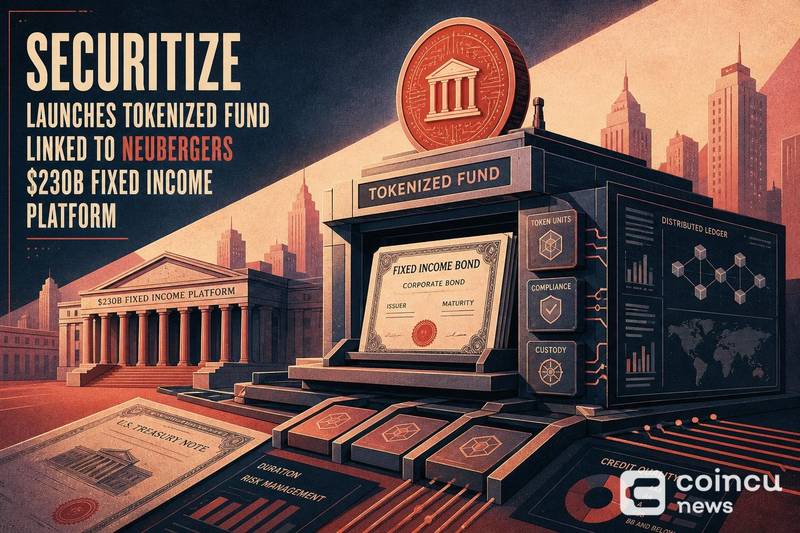
The product was introduced by Securitize in partnership with Neuberger Berman, according to the firms’ joint launch announcement. The offering connects a tokenized fund structure to Neuberger Berman’s established fixed-income business rather than to a crypto-native strategy. For related coverage, see ParaFi Capital Tokenization Launches $1B Fund On Avalanche.
In plain terms, a tokenized fund represents fund interests as blockchain-based tokens, letting the underlying investment be held and transferred on-chain. Here, that wrapper is applied to fixed-income exposure managed through Neuberger Berman’s platform.
Why Neuberger Berman’s fixed-income scale gives the launch weight
The strongest quantitative anchor in the announcement is the $230 billion fixed-income platform that underpins the fund. A fixed-income platform of that size generally spans bonds and other debt instruments managed on behalf of institutional and other clients.
Asset-management scale matters in tokenization narratives because it signals that an established manager, not an untested issuer, sits behind the product. That pedigree is what separates this launch from purely speculative crypto-native funds.
Traditional bond-oriented exposure also differs from typical crypto fund products. Its returns are tied to debt-market dynamics rather than to token price movements, so the tokenized format changes how the exposure is distributed, not the nature of the underlying asset.
What the launch signals for tokenized real-world assets
Tokenized real-world assets, or RWAs, are traditional financial instruments represented as blockchain tokens. Securitize has been among the most active issuers in this category, having previously launched a tokenized Apollo fund on the Sei network.
Fixed-income products are frequently cited as a logical category for tokenization because their cash-flow structures are well defined. The same rationale has driven other bond-focused efforts such as VanEck’s tokenized Treasury bond fund.
The involvement of an established asset manager increases the strategic relevance of the launch for institutional participation. Securitize’s tokenized products have also drawn crypto-native capital, including a reported plan by Ethena to invest in a Securitize CLO fund.
Limitations and watchpoints for investors
A tokenized wrapper does not remove the underlying fixed-income market risks. Interest-rate and credit exposure tied to the debt held by the fund remain regardless of the on-chain format.
Tokenized products can also face regulatory, custody, liquidity, and access constraints. Securitize’s own reporting that tokenized real-world assets have reached roughly $20 billion shows the category is growing but still small relative to traditional markets.
Access terms are a key open question. Readers should look for clarity on who can subscribe, under what eligibility conditions, and how redemptions work before drawing conclusions about liquidity.
FAQ about Securitize’s tokenized fund and Neuberger exposure
What is Securitize’s new tokenized fund?
It is a tokenized fund launched by Securitize with Neuberger Berman that represents fixed-income fund interests as blockchain-based tokens, per the firms’ launch announcement.
How is the fund connected to Neuberger Berman’s fixed-income platform?
The fund draws its underlying exposure from Neuberger Berman’s fixed-income business, which the firms describe as a $230 billion platform.
Why does the $230 billion figure matter?
It anchors the credibility of the offering by tying it to an established manager’s scale, though it reflects the broader platform rather than assets in the tokenized fund itself.
Who is the likely target investor?
The launch materials point to institutionally oriented fixed-income exposure delivered in a tokenized format; specific eligibility terms should be confirmed from the official pages.
What are the main risks or limitations to know?
Underlying interest-rate and credit risk remain, and tokenized structures can carry regulatory, custody, liquidity, and access constraints.
Disclaimer: This article is for informational purposes only and does not constitute financial or investment advice. Cryptocurrency and digital asset markets carry significant risk. Always do your own research before making decisions.
No tags available.


Other Posts








- China, US Conclude Trade Talks with Focus on Cooperation
- Court Upholds Fed’s Rejection of Custodia Bank’s Request
- Former CFO Convicted for $35M Fraudulent Crypto Investment
- Crypto Weekly: NYSE Backs OKX, Kraken Gets Fed Access, BTC Sells
- DeriW Launches Edge Hour Trading Competition Platform for Derivatives Traders
- Michael Saylor Denies Bitcoin Sell-Off Amid Large BTC Transfer
- Buy Dogecoin on eToro: Step-by-Step Guide for Beginners (2024)
- Kazakhstan Explores Crypto Reserves Backed by National Funds
- JPMorgan Increases Holdings in BlackRock’s Bitcoin ETF
- Nordea Bank Introduces Bitcoin ETP Trading for Nordic Customers
- XRP Spot ETF Launches on Nasdaq Amid Market Fluctuations
- Peter Schiff Challenges Michael Saylor on MSTR’s Business Model
- Thailand Orders Worldcoin to Delete 1.2 Million Biometric Records
- UK Proposes New DeFi Tax Framework to Ease User Burden
- WLFI Under Fire: Analyst Warns Hyperliquid Could Be Next
- Ancient Ethereum Whale Moves $1.19 Billion After Decade
- BlackRock Receives Large Crypto Transfers from Coinbase
- SEC Scrutiny on ALT5 Sigma’s Leadership Disclosure Timing
- Yala Injects $5.5 Million Amid Recovery Efforts
- Radiant Capital Faces $50M Loss in Major Security Breach
- China, US Conclude Trade Talks with Focus on Cooperation
- Court Upholds Fed’s Rejection of Custodia Bank’s Request
- Former CFO Convicted for $35M Fraudulent Crypto Investment
- Crypto Weekly: NYSE Backs OKX, Kraken Gets Fed Access, BTC Sells
- DeriW Launches Edge Hour Trading Competition Platform for Derivatives Traders
- Michael Saylor Denies Bitcoin Sell-Off Amid Large BTC Transfer
- Buy Dogecoin on eToro: Step-by-Step Guide for Beginners (2024)
- Kazakhstan Explores Crypto Reserves Backed by National Funds
- JPMorgan Increases Holdings in BlackRock’s Bitcoin ETF
- Nordea Bank Introduces Bitcoin ETP Trading for Nordic Customers
- XRP Spot ETF Launches on Nasdaq Amid Market Fluctuations
- Peter Schiff Challenges Michael Saylor on MSTR’s Business Model
- Thailand Orders Worldcoin to Delete 1.2 Million Biometric Records
- UK Proposes New DeFi Tax Framework to Ease User Burden
- WLFI Under Fire: Analyst Warns Hyperliquid Could Be Next
- Ancient Ethereum Whale Moves $1.19 Billion After Decade
- BlackRock Receives Large Crypto Transfers from Coinbase
- SEC Scrutiny on ALT5 Sigma’s Leadership Disclosure Timing
- Yala Injects $5.5 Million Amid Recovery Efforts
- Radiant Capital Faces $50M Loss in Major Security Breach
- China, US Conclude Trade Talks with Focus on Cooperation
- Court Upholds Fed’s Rejection of Custodia Bank’s Request
- Former CFO Convicted for $35M Fraudulent Crypto Investment
- Crypto Weekly: NYSE Backs OKX, Kraken Gets Fed Access, BTC Sells
- DeriW Launches Edge Hour Trading Competition Platform for Derivatives Traders
- Michael Saylor Denies Bitcoin Sell-Off Amid Large BTC Transfer
- Buy Dogecoin on eToro: Step-by-Step Guide for Beginners (2024)
- Kazakhstan Explores Crypto Reserves Backed by National Funds
- JPMorgan Increases Holdings in BlackRock’s Bitcoin ETF
- Nordea Bank Introduces Bitcoin ETP Trading for Nordic Customers
- XRP Spot ETF Launches on Nasdaq Amid Market Fluctuations
- Peter Schiff Challenges Michael Saylor on MSTR’s Business Model
- Thailand Orders Worldcoin to Delete 1.2 Million Biometric Records
- UK Proposes New DeFi Tax Framework to Ease User Burden
- WLFI Under Fire: Analyst Warns Hyperliquid Could Be Next
- Ancient Ethereum Whale Moves $1.19 Billion After Decade
- BlackRock Receives Large Crypto Transfers from Coinbase
- SEC Scrutiny on ALT5 Sigma’s Leadership Disclosure Timing
- Yala Injects $5.5 Million Amid Recovery Efforts
- Radiant Capital Faces $50M Loss in Major Security Breach

Securitize Launches Tokenized Fund Linked to Neuberger’s $230B Fixed-Income Platform


Metaplanet Moves Into the US With a $132M Bitcoin Treasury Deal


Vantage Expands Pre-IPO CFD Offering with Unitree Robotics as Interest in Frontier AI Grows